800-942-7123 Call Now Book a Free Inspection

Drain Fly

Learn About Drain Flies - Habitat, Diet, Life Cycle, And Dangers

Unlike most flies that find their way into a building, drain flies come from within the plumbing itself. They breed inside the gelatinous film that coats pipes, p-traps, and floor drains, and emerge just a few feet from where they hatched, which is why surface cleaning never seems to fix them. Across New JerseyDownstate NY and Connecticut, they're a recurring headache for restaurants, hotels, and healthcare sites, where constant water use and overlapping shift rotations leave plenty of room for hygiene to slip.

For operators balancing inspection scores, guest experience, and back-of-house workload, identifying drain flies early and tracing them back to the source is what separates a manageable issue from a compliance one.

Quick Facts About Drain Flies

  • Drain flies belong to the same family (Psychodidae) as sand flies, known to transmit leishmaniasis in other parts of the world.
  • Larvae have a built-in snorkel, or breathing tube, at the rear that lets them survive submerged in slime and stagnant water.
  • Drain fly larvae are transparent, which is why you almost never see them, even when peering directly into a drain.
  • They don't need much water to breed; a thin film of moisture inside a pipe is enough to sustain a population.
  • Drain fly larvae can survive brief exposure to boiling water and bleach, which is why pouring either down a drain rarely solves the problem.
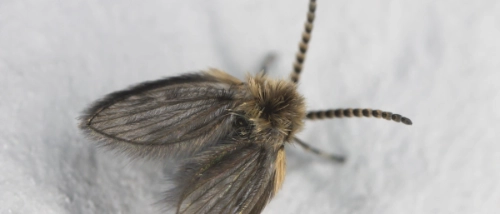
A drain or sewage fly on a white wall

What Are Drain Flies

What do drain flies look like? Adults are 2–5 mm long, grey to tan, with rounded, hair-covered wings held flat over the body at rest. Often called moth flies for their fuzzy, moth-like appearance, drain flies (Psychodidae) breed in the slime layer found in drains, traps, and standing water. That fuzzy outline is the easiest way to tell them apart from other small flies in your facility. 

So what causes drain flies? Almost always, it's decaying organic debris in your plumbing. Food residue, hair, soap scum, and grease combine into a biofilm that lines pipes, p-traps, and floor drains. Drain fly larvae develop inside that slime, feeding on the bacteria and decomposing material it contains. As long as the biofilm is there, the cycle continues.

Mistaking drain flies for fruit flies is the most common mix-up. Fruit flies are tan or brown, with heart-shaped wings and red or black eyes. They hover around rotting produce, fermenting liquids, grease, and drain slime. It's useful to know the difference because this determines the treatment and prevention strategy for the best results.
Habitat, Diet, Life Cycle, and Behaviors

What you see in the kitchen or washroom wall isn't where the problem lives. Adult drain flies are easy to spot, but they breed out of sight, and the population will keep regenerating until the source is removed. Understanding how they survive is what turns a recurring problem into a more enduring long-term solution.

Drain flies live wherever stagnant water and decaying matter converge. This means floor drains, p-traps under prep sinks, mop sinks, grease traps, dishwasher overflow lines, soda gun wells, and the rarely-used drains in basements, restrooms, and storage rooms. External hotbeds for breeding include damp areas around sewer access points, septic systems, and condensate lines from HVAC units. Anywhere water sits long enough for a biofilm layer to form is a potential breeding site.

Adults feed mostly on nectar, polluted water, or sugary residues, but don't live long enough to be a significant threat to businesses. The real activity happens at the larval stage. Drain fly larvae in slime feed on the bacteria, fungi, and decomposing matter that make up biofilm. That's why a drain that looks clean on the surface can still produce hundreds of flies: the food source is the layer coating the inside of the pipe, not anything visible from above.

Drain flies move through their full life cycle in 8–24 days, depending on temperature and food availability. Females lay 30–100 eggs at a time directly into the gelatinous film inside drains and pipes. Larvae hatch within 48 hours and feed inside the biofilm for 9–15 days before pupating. Adults emerge fully formed and live for around two weeks, mating and laying eggs almost immediately. In a warm commercial kitchen, that means a single untreated drain can sustain successive populations year-round.

Drain flies are weak, clumsy fliers. You'll usually see them resting motionless on walls, ceilings, or surfaces near their breeding site, and when disturbed, they hop a short distance rather than taking off cleanly. They're most active at night and tend to stay within a few feet of where they emerged, which is actually useful: a cluster of drain flies in a specific area almost always points directly to the drain or moisture source feeding them.

Commercial Concerns with Drain Flies

Drain flies are a leading cause of low regulatory scores in food service and healthcare inspections because their mere presence raises concerns. Populations suggest poor sanitation deep inside your pipework, which is exactly what inspectors are trained to look out for. A visible drain fly during a walk-through is, by itself, a finding. A breeding population is a violation.

They also carry a sanitation risk. Drain flies don't bite or sting, but larvae develop in the bacteria-rich films inside drains connected to sewage lines, and adults can transfer that microbial load onto food-contact surfaces, which is a real concern in healthcare, food service, and hospitality environments. 

The industries most exposed include:

A drain fly sighting might look like a minor pest issue, but in a regulated facility, it reads as a sanitation failure. That's the difference between a clean report and a corrective action.

Seeing Drain Flies?

Call now to book your free inspection.

Frequently Asked Questions

Drain flies are caused by biofilm inside drains, traps, and pipes. As food residue, soap scum, grease, and hair decompose, they form a slime layer that coats the inside of plumbing—and that's where drain fly larvae feed and develop. Any drain that isn't used or cleaned regularly can become a breeding site. In commercial settings, the usual culprits are floor drains, mop sinks, and grease traps.

Knowing how to kill drain flies is only half the job. The adults you see are easy to eliminate, but unless you remove the biofilm in which the larvae are developing, the population rebuilds within days. Bleach and boiling water can kill adult flies, but they don't remove the larvae-filled biofilm,  which means populations continue to grow. Effective treatment requires mechanically scrubbing the inside of the pipe with a stiff brush, followed by an enzymatic or biological drain cleaner that digests the organic film. For commercial properties with multiple drains, grease traps, or hard-to-access plumbing, professional drain fly treatment is far more reliable than DIY solutions.

Drain flies don't bite, sting, or transmit disease in the way mosquitoes or biting flies do. However, because they breed in raw sewage and rotting organic matter, they can have an indirect impact on hygiene and health risks.

Prevention comes down to ongoing drain hygiene. That means scheduled deep cleaning of floor drains, p-traps, and grease traps; flushing seldom-used drains weekly to prevent biofilm formation; and keeping prep areas dry at the end of each shift. Enzymatic drain treatments, applied on a routine schedule, break down organic buildup before it becomes a breeding ground. For multi-unit or high-volume operations, a preventive drain treatment program is the most reliable way to keep drain flies from coming back.

Find Your Local Branch

Go

Get in Touch

Contact Assured Environments now to arrange a free risk assessment and explore tailored solutions for your commercial site.

About Us

Learn about Assured Environments, the best commercial pest control for New York and the surrounding area. Get Assured Environments pest control services today.