800-942-7123 Call Now Book a Free Inspection

Fruit Flies

Learn About Fruit Flies - Habitat, Diet, Life Cycle, And Dangers

Fruit flies can appear out of nowhere. One day, your kitchen is spotless; the next, swarms of them are hovering over the bar mat or food prep surfaces. For businesses across New Jersey, New York, and Connecticut, a hovering mass like this alerts staff, customers, and inspectors to a potential lapse in hygiene, which can negatively impact your business. Lost revenue, failed health inspections, and poor reviews often follow close behind. 

Here's what you need to know to spot the warning signs, head off an infestation, and decide your next move—with or without professional fruit fly services.

Quick Facts About Fruit Flies

  • Commercial sites face two different species. Red-eyed flies prefer rotting food, while dark-eyed flies breed in heavy grease
  • Around 60% of human disease-related genes have an equivalent in fruit flies, making them a staple of medical research.
  • Their growth stops completely below 60°F (16°C). Keeping storage areas cold is a great way to prevent outbreaks.
  • Males court females with a "song" — a precise wing vibration unique to their species. This allows them to breed hidden inside walls before you notice them.
  • They experience deep sleep cycles. During this downtime, they hide in structural cracks and completely miss daytime cleaning shifts.
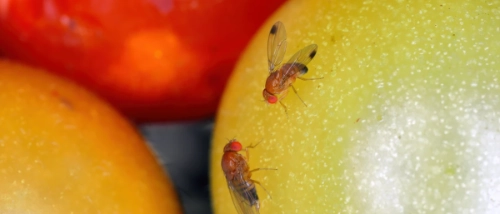
Fruit flies feeding on soft fruits

What Are Fruit Flies

Fruit flies are small, winged insects in the family Drosophilidae, usually about one-eighth of an inch long. They are commonly called vinegar flies due to their fondness for the acetic acid produced when sugars break down. Their red eyes, tan bodies, and slow, hovering behavior set them apart from house flies and other small kitchen flies.

But where do fruit flies come from? More often than not, they hitch a ride on the produce delivered to your kitchen. A few overripe tomatoes or a forgotten case of bananas in the back of a walk-in is enough to sustain a full-blown infestation. Once they find an ideal fruit fly breeding ground, populations quickly multiply because of their short reproductive cycle.

Their preference for overripe fruit and fermented products, including spilled beer, wine drip trays, kombucha lines, and soda gun holsters, makes commercial kitchens, bars, and produce-handling facilities prime targets.

Habitat, Diet, Life Cycle, and Behaviors

Tracing the conditions that sustain fruit fly populations back to the source separates a quick fix from a recurring problem. Only by finding and cleaning out the specific breeding sites (drains, bins, or storage corners) can you prevent new flies from emerging week after week. To do this, you need to know about fruit fly habits and behavior.

Red-eyed fruit lifes eat fermenting organic matter, which is why even a thin film of spilled juice or a half-empty wine glass left overnight is enough to draw them in. Conversely, black fruit flies prefer decaying debris found in great traps, floor drains, and beer taps. Their larvae, however, consume decaying matter from the inside where their mother laid her eggs, whether overripe fruit, the slime film inside a drain, residue at the bottom of a recycling bin, or the soft spot on a forgotten onion. 

Red-eyed fruit lifes eat fermenting organic matter, which is why even a thin film of spilled juice or a half-empty wine glass left overnight is enough to draw them in. Conversely, black fruit flies prefer decaying debris found in great traps, floor drains, and beer taps. Their larvae, however, consume decaying matter from the inside where their mother laid her eggs, whether overripe fruit, the slime film inside a drain, residue at the bottom of a recycling bin, or the soft spot on a forgotten onion.

Here, the math works against you and your business: fruit fly eggs hatch within 24 hours, larvae feed for roughly four days, and new adults are ready to mate almost immediately after emerging. In warm kitchen conditions (around 85°F / 29°C), a full generation takes just over a week to mature—meaning a handful of flies on Monday can become hundreds by the following week. Females also store sperm after a single mating, allowing them to keep producing fertile eggs for the rest of their lives without needing a male nearby. 

That speed is why early intervention matters so much; even a 48-hour delay can mean the difference between a localized issue and a facility-wide problem.

Fruit flies hover rather than dart, making them easy to identify but frustrating to swat, because their compound eyes process motion roughly four times faster than ours, so they almost always see the hand coming. 

They're drawn to light, CO₂, and ethanol, which explains why they are attracted to bars, breweries, and dining rooms with high footfall and plenty of alcohol. Females are very picky about where they lay their eggs and search for surfaces where their offspring can hatch directly onto a food supply. That's why the same few drains, bins, or storage corners keep producing new flies week after week.

Commercial Concerns with Fruit Flies

Facility managers and frontline staff across all sectors need to be on the lookout for fruit flies. In public-facing businesses, visible pests can easily end up in customer photos or negative online reviews. In corporate settings, they disrupt employee productivity and signal a lack of facility cleanliness.

While fruit flies don't bite or sting, they are a contamination risk. As they move between drains, garbage, and decaying produce, they pick up and transfer pathogens, such as E. coli, Salmonella, and Listeria, onto food-contact surfaces. In any environment subject to health inspections or food safety audits, that's enough to turn a minor sighting into a serious liability.

Equally, the flies you see rarely tell the full story and are often a sign of a larger issue; they may indicate a sluggish drain, moisture seeping into a hairline crack, or grease accumulating inside a line.

The industries most exposed include:

Fruit flies may look harmless, but the contamination risk makes them a regulatory concern rather than simply a cosmetic one. In a tightly regulated facility, that distinction really matters.
Seeing Fruit Flies?

Call now to book your free inspection.

Frequently Asked Questions

Females lay eggs on or just beneath the surface of fermenting organic material, like soft fruit, vegetable peels, the slime film inside drains, dirty mop heads, and the residue inside recycling bins. A single female can lay up to 500 eggs over her lifetime, which is why even a small overlooked source can produce a major infestation in days.

Fruit flies are characterized by their tan-to-brown bodies, and slow hovering flight. Unlike house flies, they're far smaller (1/8 inch) and tend to stay close to their food source. Compared to other flies we treat, like drain flies or spotted lanternflies, they're uniquely tied to fermenting sugars and produce.

Under ideal warm, food-rich conditions, adult fruit flies can survive up to 30 days. However, the bigger concern isn't their lifespan, it's their reproductive speed. With a generation completing in roughly a week, populations can double several times before you finish troubleshooting the source.

No, although they're often confused. In the gnat vs. fruit fly comparison, fruit flies have rounded tan bodies, black or red eyes and are tied to fermenting produce. Fungus gnats are darker, more mosquito-like in shape, and breed in overwatered soil or damp organic debris. Drain flies (sometimes called moth flies) are fuzzy and gray. Correct identification is essential because each requires a different treatment approach.

Find Your Local Branch

Go

Get in Touch

Contact Assured Environments now to arrange a free risk assessment and explore tailored solutions for your commercial site.

About Us

Learn about Assured Environments, the best commercial pest control for New York and the surrounding area. Get Assured Environments pest control services today.