800-942-7123 Call Now Book a Free Inspection

House Mouse Facts: Identification & Information

Finding mice in your building is never a welcome discovery. Small, secretive, and quick to multiply, house mice are one of the most widespread pest problems across the country. Dealing with them effectively starts with understanding exactly what you're up against.

Quick Facts About House Mice

  • House mice breed year-round indoors, making them a persistent problem in any season
  • Brown mice with grey tones and a pointed snout; they're often mistaken for other small rodent species
  • A single house mouse can produce up to 60 offspring in the space of one year
  • Signs of mice on your premises include droppings, gnaw marks, greasy smear trails, and musky odors
  • House mice contaminate food and surfaces through their droppings, urine, and constant shedding of fur
  • They're capable of gnawing through electrical insulation, creating a genuine fire risk inside walls and ceilings
     
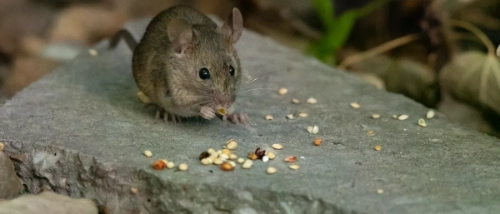
House mouse foraging on birdseed

What Are House Mice?

Scientifically known as Mus musculus, the house mouse is a small, nimble rodent that has lived alongside humans for thousands of years. Typically grey-brown in color with a lighter belly, they have a slender build, large rounded ears, and a long scaly tail. Unlike more seasonally driven species such as the deer mouse, house mice establish permanent indoor colonies and rarely stray far from their nesting site once settled.

Seeing House Mice?

Contact us today for your free inspection.

Habitat, Diet, Life Cycle, and Behaviors

The house mouse has spent centuries adapting to human environments, which makes it exceptionally good at living alongside us undetected. With a flexible diet, rapid breeding cycle, and a talent for squeezing into the tightest of spaces, it's one of the more resilient pests a commercial property can face throughout the year.

Where Do House Mice Live?

Indoors, house mice gravitate toward warm, hidden spaces close to food. Wall voids, under appliances, inside storage areas, and behind insulation are all favored nesting spots. They rarely venture more than 30 feet from their nest, which means an infestation can remain tightly contained in one area of a building for quite some time before it's noticed.

What Do House Mice Eat?

House mice prefer grains, cereals, seeds, and high-carbohydrate foods, but they'll eat almost anything available when preferred options run out. Chocolate, butter, and nesting materials have all been recorded as target foods. They eat little and often, visiting multiple food sources in a single night. This feeding pattern means contamination can spread across a wide area.

House Mouse Lifecycle

A female house mouse reaches reproductive maturity at around six weeks and can produce between five and ten litters per year, with four to eight pups per litter. Gestation lasts around 19 to 21 days. Because breeding continues year-round indoors, without the seasonal slowdown that affects outdoor species, populations can grow rapidly without early intervention.

House Mouse Behaviors

House mice follow fixed routes between their nest and food sources, running close to walls and leaving greasy smear marks along their regular paths. Naturally curious, they'll investigate new objects in their environment more readily than rats. They're active mostly at night but can sometimes be spotted during daylight hours when populations are high. Their constant gnawing is driven by the need to stop their incisor teeth becoming too long.
Commercial Concerns with House Mice

In any commercial setting, mice on your premises can lead to consequences such as contaminated stock, failed inspections, and potential forced closures. 

House mice are a serious concern across all sectors, as their activity can create fire and equipment failure risks. Equally, the health implications of droppings and urine near workspaces create real liability issues for employers, while staff morale and customer confidence can both take a hit when a rodent is spotted on-site. A proactive monitoring program is a smarter investment than emergency treatment after the fact.
 

Frequently Asked Questions

House mice can squeeze through an opening the size of a pencil, so cracks around pipes, gaps under doors, unscreened vents, and spaces around utility cables are all common entry routes. High-traffic buildings with frequent deliveries and open loading bays are particularly exposed, as mice can slip in alongside incoming goods without anyone noticing.

Most commonly, they move in from nearby outdoor habitats when food becomes scarce or temperatures drop. Neighboring infested properties, drains, and overgrown areas adjacent to buildings all act as source populations. Once one mouse finds a viable entry point, others follow the scent trail it leaves behind, which is why problems can escalate quickly across a commercial site.

Key signs of mice include small dark droppings along walls or in storage areas, damaged packaging and chewed woodwork, greasy smear marks at floor level, and a persistent musky smell in enclosed spaces. Scratching sounds behind walls at night and shredded nesting material tucked into hidden corners are also strong indicators of active house mouse presence.

Brown mice is a loose term that gets applied to several species. The house mouse is typically grey-brown rather than a deep rich brown, with a paler underside and a uniform coat. Darker rodents are more likely to be a different species entirely. If the mouse spotted on your premises looks noticeably darker or almost black in color, it's worth checking our black mice species page to see whether a different identification fits better.

The house mouse differs from both in meaningful ways. Compared to the deer mouse, it lacks the sharp two-toned coloring and bicolored tail. Next to a field mouse, it tends to be slightly smaller and more uniform in color, and emits a strong musky odor. Behaviorally, the biggest distinction is that house mice commit fully to indoor living, while field and deer mice tend to move in seasonally and maintain stronger ties to outdoor habitats.

Find Your Local Branch

Go

Get in Touch

Contact Assured Environments now to arrange a free risk assessment and explore tailored solutions for your commercial site.

About Us

Learn about Assured Environments, the best commercial pest control for New York and the surrounding area. Get Assured Environments pest control services today.